
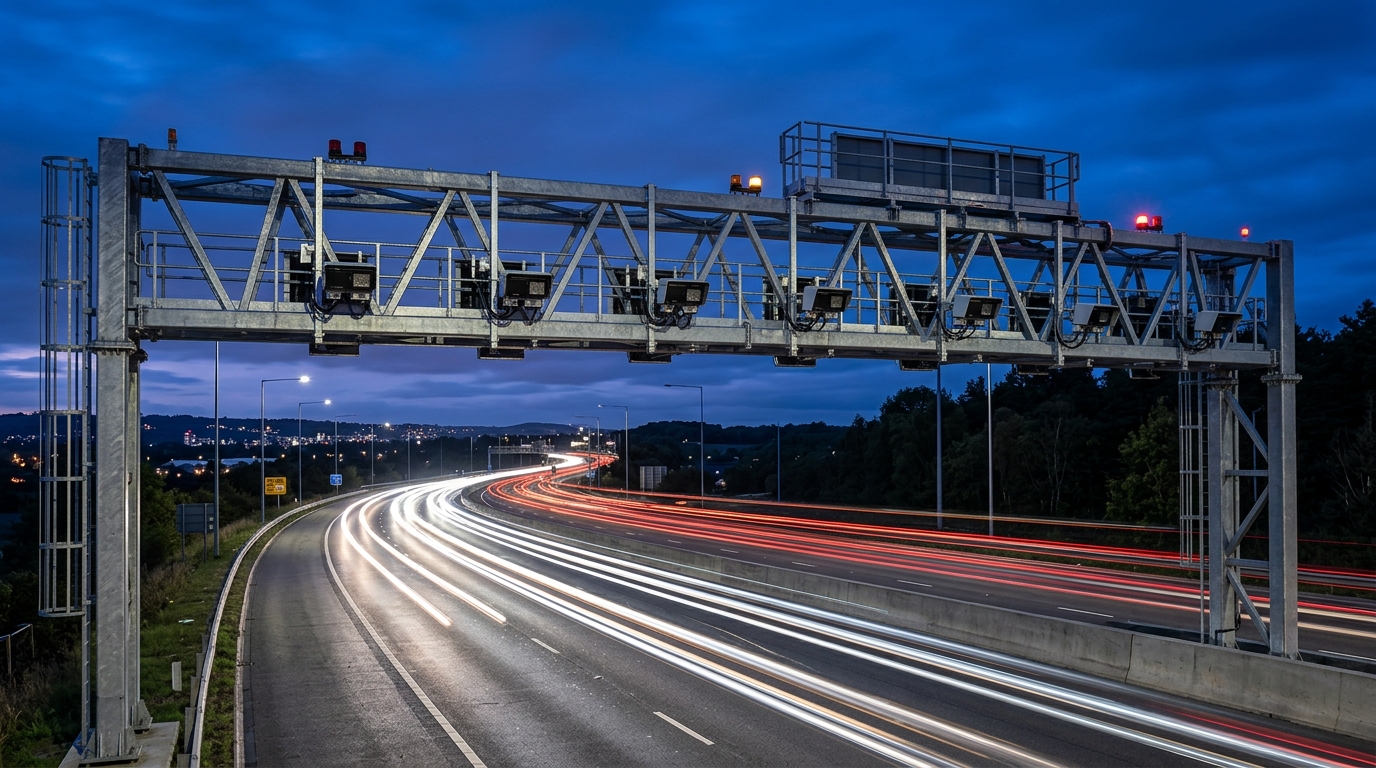
Executive Briefing
- Market Trajectory: According to Global Market Insights Inc., the Automatic Number Plate Recognition (ANPR) market is poised for aggressive compound annual growth leading toward 2034, driven by multi-modal ITS (Intelligent Transportation Systems) and frictionless tolling.
- Architectural Shift: Decoupling legacy analog capture cards in favor of embedded edge Neuromorphic/Tensor Processing Units (NPUs/TPUs) operating at sub-15ms inference latency.
- Optical Challenges: Retroreflective degradation, hyper-angled plate skewing (>45 degrees), and variable dynamic range lighting require active infrared pulsed strobing synchronized with global shutters.
- Strategic Imperative: Migration from centralized batch processing to hybrid cloud telemetry, eliminating upstream bandwidth bottlenecks while upholding stringent ISO/IEC 27001 and GDPR data boundary compliance.
The 2034 Macro Horizon: The Evolution of Optical Vehicle Tracking
The global Automatic Number Plate Recognition (ANPR) landscape is undergoing an unprecedented structural realignment. As underscored in the recent Automatic Number Plate Recognition System Market Report, 2034 by Global Market Insights Inc., the sector is expanding far beyond static municipal surveillance. We are observing deep convergence across free-flow Open Road Tolling (ORT), automated logistics yard orchestration, and barrier-free parking architectures.
Historically, ANPR solutions relied on server-side Optical Character Recognition (OCR) heuristics applied to standard MJPEG or low-frame-rate RTSP streams. This legacy topology incurred severe network bandwidth consumption, fragile packet drops, and high false-positive rates during peak ingress. By 2034, enterprise demands will mandate edge-native inference engines capable of 99%+ real-time accuracy under adverse environmental stressors such as high vehicle velocities (>200 km/h), deep specular blooming, and acute sensor perspective angles.
Physical Layer & Edge Processing: Overcoming Physics at the Shutter
Achieving deterministic plate capture requires eliminating physical optical distortion before digital tensors process the pixel grid. The modern ANPR capture pipeline relies on three baseline hardware requirements:
- Global Shutter CMOS Sensors: Rolling shutter distortion renders alphanumeric characters illegible at high relative speeds. Global shutter intervals operating at sub-millisecond exposures (1/2,000s to 1/10,000s) freeze vehicle motion without directional tearing.
- Active Bandpass Infrared (IR) Illumination: Using narrow-spectrum 850nm or 940nm pulsed IR synchronized via hardware TTL pulses suppresses daytime headlight glare and penetrates nighttime atmospheric interference, optimizing visibility for retroreflective plates.
- Dynamic Optical Focal Skew Compensation: Modern installations frequently encounter non-standard vertical and horizontal incident angles. Edge-based perspective rectification networks mathematically de-skew skewed quadrilateral license plate patches into planar, orthogonal orientations prior to character segmentation.
ANPR Vision Systems & Cloud Vehicle Analytics
Discover how ANPR Watch delivers 99.4% optical character accuracy for automated parking enforcement, highway tolling, and security checkpoints.
Deep Learning Inference Pipelines: From Bounding Boxes to Semantic Context
The core software stack is transitioning from classic template-matching algorithms to multi-stage Convolutional Neural Networks (CNNs) and Vision Transformers (ViTs). State-of-the-art vision pipelines utilize lightweight target detection models (such as customized YOLOv8 or dynamic anchor-free architectures) compiled specifically for hardware accelerators like ONNX Runtime, TensorRT, or low-power Hailo NPUs.
Modern inference is executed in a multi-stage deterministic pipeline:
- Vehicle Localization & Tracking: Optical tracking nodes isolate the vehicle bounding box across consecutive frames using Kalman filtering and ByteTrack algorithms.
- License Plate Region of Interest (RoI) Extraction: A secondary micro-network isolates the exact license plate coordinates, even under partial occlusion or dirty surfaces.
- Character Sequence Prediction: Connectionist Temporal Classification (CTC) layers or auto-regressive transformer decoders read complex alphanumeric layouts, handling multi-line plates and diverse jurisdictional typographies seamlessly.
- Make, Model, Color, and Class (MMCC) Attribution: Concurrently, tertiary classifiers infer auxiliary metadata to detect plate-cloning anomalies in real time.
Strategic Implementation Matrix: Modern vs. Legacy Architecture
Enterprise stakeholders evaluating next-generation ANPR/ALPR infrastructure must benchmark potential systems across several mission-critical operational vector parameters:
| Operational Metric | Legacy ANPR Architecture | 2026-2034 Edge-Cloud Architecture |
|---|---|---|
| Capture Reliability | 88.0% – 93.5% (High ambient dependency) | 99.0% – 99.8% (Multi-spectral IR/RGB fusion) |
| Bandwidth Consumption | Continuous 4-8 Mbps per stream (H.264/RTSP) | <50 Kbps per vehicle (JSON metadata + crop) |
| End-to-End Latency | 800ms – 2,500ms (Network dependent) | <40ms (On-premise edge validation) |
| Data Governance | Unencrypted video backhaul pipelines | Encrypted payload (AES-256) + auto-anonymization |
Enterprise Compliance, Privacy, and Scalability
By 2034, compliance standards such as GDPR, CCPA, and regional PII mandates will penalize systemic data hoarding. Edge architecture provides an inherent compliance firewall: systems can be configured to permanently drop full-frame high-resolution video at the sensor layer, persisting and transmitting only the cryptographic character payload, cryptographic timestamp, and a cropped plate image.
For large-scale smart parking networks, free-flow toll systems, and corporate facilities, standardizing on edge-computed ANPR provides operational decoupling. Sites continue automated gate arbitration, occupancy calculations, and enforcement workflows via local subnets even during metropolitan WAN outages.
Enterprise FAQ: Strategic ANPR Procurement
How do 2034 edge ANPR architectures address vehicle plate occlusions and dirt?
Next-generation systems use multi-frame temporal consensus algorithms. Instead of relying on a single static frame, the system runs inference across 15 to 30 frames captured during approach, aggregating probabilistic character weightings to reconstruct damaged or partially occluded alphanumeric strings accurately.
Can modern edge ANPR operate over cellular IoT networks (LTE-M/5G RedCap)?
Yes. Because all image processing and character extraction happens directly on the camera hardware via an onboard NPU, only lightweight structured JSON telemetry (containing license string, confidence metric, timestamp, and an optional 50KB plate crop) is transmitted, requiring minimal bandwidth.
What optical shutter speed is required to capture vehicles at highway speeds?
For vehicles traveling between 100 km/h and 200 km/h, optical shutters must be locked between 1/2,000s and 1/4,000s, coupled with dynamic pulsed infrared illumination to guarantee zero motion blur while preserving sufficient sensor illumination.
