
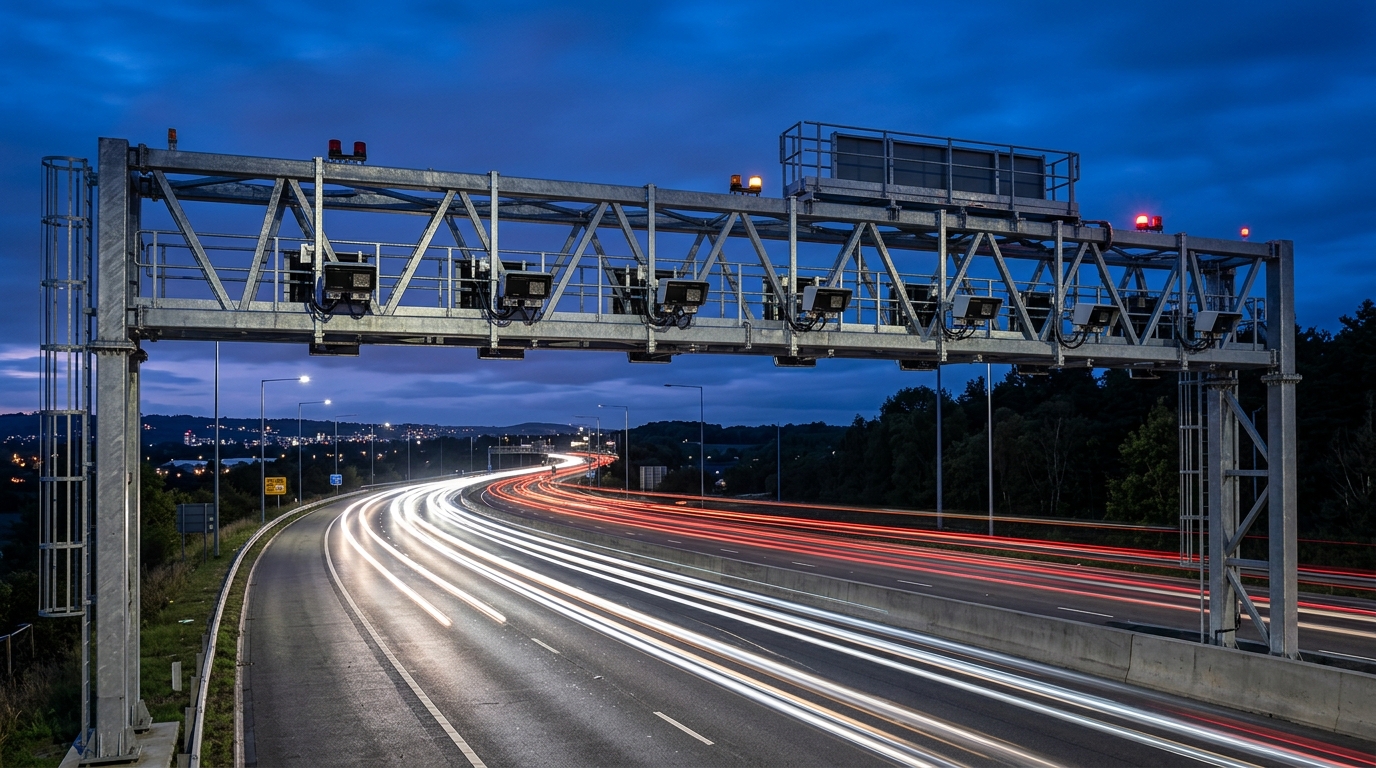
Executive Briefing
- Examines the architectural implications of PLUS Malaysia’s large-scale automated number plate recognition (ANPR) rollout across southern highway corridors.
- Analyzes optical engineering challenges including variable shutter speeds, glare management, and motion blur at highway velocities.
- Provides a strategic blueprint for migrating tolling and parking operations from legacy RFID to high-accuracy computer vision networks.
The announcement by Projek Lebuhraya Utara-Selatan (PLUS) to expand its Automatic Number Plate Recognition (ANPR) infrastructure into southern regions marks a watershed moment for intelligent transportation systems (ITS) in Southeast Asia. For enterprise architects, transportation executives, and municipal parking operators, large-scale highway deployments serve as the ultimate stress test for optical capture, edge computing, and real-time database reconciliation.
Moving beyond basic closed-circuit television, modern enterprise ANPR relies on high-frequency CMOS sensors, near-infrared (NIR) illuminators, and deep learning optical character recognition (OCR) models operating at the network edge. As national highway networks scale to process hundreds of thousands of transactions per hour at highway speeds, system reliability, latency constraints, and environmental resilience dictate operational ROI.
The Technical Anatomy of High-Velocity ANPR Deployments
Deploying ANPR across high-speed corridors like the PLUS network introduces severe physical and computational challenges. Vehicles traveling in excess of 110 km/h demand sub-millisecond shutter intervals to eliminate motion blur, coupled with adaptive IR strobes that compensate for environmental luminance shifts between blinding tropical sunlight and torrential monsoonal downpours.
Optical and Sensor Architecture
Achieving a 99%+ capture rate requires specialized optical arrays. Key engineering specifications include:
- Global Shutter CMOS Sensors: Eliminates rolling shutter distortion caused by high-speed lateral vehicle movement.
- Narrow-Band NIR Pass Filters (850nm / 940nm): Blocks ambient visible light interference, ensuring consistent plate contrast regardless of headlights or glare.
- Edge-Computing OCR Acceleration: Localized neural processing units (NPUs) running quantized YOLOv8 and CRNN (Convolutional Recurrent Neural Network) models to extract license plate alphanumeric sequences in under 45 milliseconds.
ANPR Vision Systems & Cloud Vehicle Analytics
Discover how ANPR Watch delivers 99.4% optical character accuracy for automated parking enforcement, highway tolling, and security checkpoints.
Transitioning from Legacy RFID to Vision-Based Toll & Parking Infrastructures
While RFID tags have long served as the backbone for electronic toll collection (ETC), they suffer from high maintenance overheads, battery degradation, and tag misreads due to improper windshield placement. Highway operators and commercial real estate portfolio managers are pivoting toward hybrid architectures where ANPR serves as a primary identifier or fail-safe redundancy layer.
Architectural Trade-Off Comparison
| Evaluation Metric | Legacy RFID Toll Systems | Next-Gen Enterprise ANPR |
|---|---|---|
| Vehicle Dependency | Requires physical transponder/tag | Zero vehicle-side hardware required |
| Maintenance Overhead | High antenna calibration & battery failure | Low optic cleaning & edge firmware updates |
| Data Enrichment | Account ID only | Make, model, color, and timestamp analytics |
| Accuracy Under Stress | Degrades with speed & interference | Maintains 99%+ with deep learning OCR |
Implementation Checklist for Enterprise ANPR Deployments
Deploying an enterprise-grade optical capture network across complex roadways or multi-level parking facilities demands rigorous systems integration engineering. Use this framework when planning your rollout:
- Site Survey & Geometry Analysis: Calculate gantry mounting heights and horizontal angles to ensure skew angles remain under 30 degrees for optimal OCR parsing.
- Network Resilience & Failover: Implement local SQLite caching on edge cameras to prevent data loss during fiber backhaul interruptions.
- Data Privacy & Compliance: Ensure compliance with regional data protection frameworks (such as Malaysia’s PDPA) by hashing plate strings and encrypting payloads in transit (TLS 1.3) and at rest (AES-256).
- Illumination Calibration: Fine-tune infrared flash duration against local speed limits to prevent motion smear during peak night traffic.
Enterprise FAQ
How does heavy tropical weather impact ANPR accuracy?
Heavy rainfall, fog, and mist can degrade visible-light cameras. Enterprise deployments mitigate this by utilizing pulsed 850nm near-infrared illumination coupled with polarization filters that cut through water vapor reflection, maintaining high OCR fidelity during extreme weather.
What is the ideal mounting height and angle for highway ANPR cameras?
For high-speed gantry deployments, cameras should be mounted between 5.5 to 6.5 meters high, maintaining a horizontal capture angle of no more than 20 to 25 degrees relative to the vehicle’s trajectory to minimize character distortion.
Can ANPR integrate with existing parking management and payment gateways?
Yes. Modern ANPR platforms expose robust RESTful APIs and MQTT message brokers, allowing seamless integration with enterprise billing engines, barrier gate controllers, and ERP financial ledgers.