
Executive Briefing
- Recent operational trials by Greater Manchester Police demonstrate that real-time Automatic Number Plate Recognition (ANPR) feeds integrated into central control rooms can catalyze a dramatic surge in apprehension rates, securing 22 high-priority arrests within a single operational week.
- Enterprise-grade optical character recognition (OCR) and low-latency edge computing are now fundamental components of municipal, commercial, and law enforcement security architectures.
- Scaling these systems requires precise tuning of optical shutter intervals, infrared (IR) illumination arrays, and fault-tolerant cloud analytics pipelines to handle high-velocity vehicular throughput.
The Operational Imperative: Real-Time Intelligence in Control Rooms
The announcement that a localized Automatic Number Plate Recognition trial resulted in 22 arrests in just seven days underscores a critical evolution in physical security and municipal oversight. Historically, ANPR systems operated in a passive forensic capacity – recording plate strings, timestamps, and geolocation coordinates into siloed databases for post-incident investigation. Today’s enterprise requirements demand real-time streaming, sub-second API lookups against national and corporate hotlists, and instantaneous dispatch triggers.
When high-definition optical capture intersects with edge-computed neural networks, control rooms transform from reactive response hubs into proactive threat interception centers. Achieving this operational velocity requires meticulous hardware selection, robust network topologies, and algorithms capable of processing complex spatial and environmental variables.
Architectural Anatomy of High-Yield ANPR Deployments
Deploying an ANPR ecosystem capable of supporting mission-critical interdiction requires addressing several distinct engineering challenges across the optical, network, and data layers:
1. Optical Capture and Illumination Physics
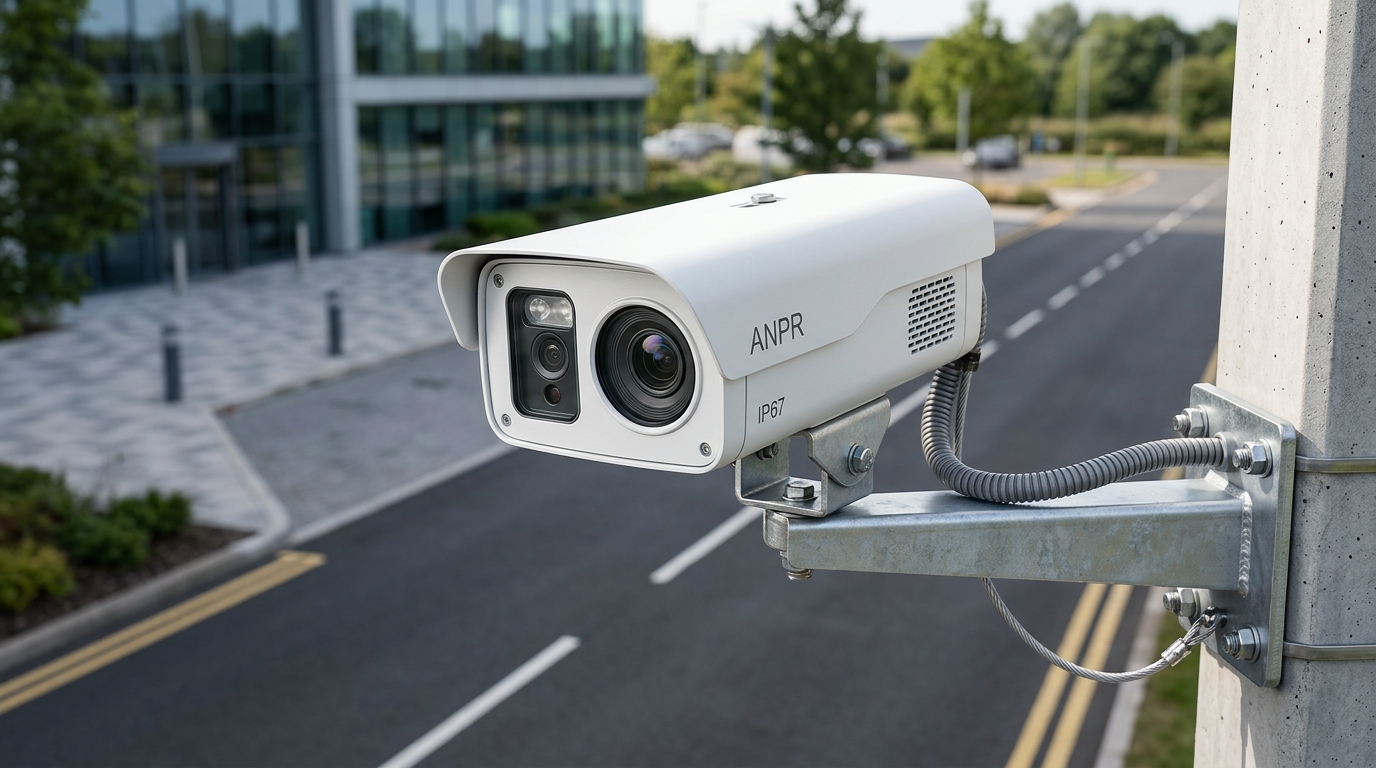
Vehicle speed, retro-reflective plate degradation, and extreme lighting variance (from direct glare to pitch-black nighttime conditions) compromise standard optical sensors. Enterprise ANPR cameras utilize synchronized pulsed infrared (850nm or 940nm) LED arrays coupled with global shutter sensors. This configuration freezes high-speed motion up to 160 km/h, eliminates motion blur, and neutralizes headlight glare by capturing images independent of ambient visible spectrum lighting.
2. Edge Processing vs. Centralized Cloud Inference
While cloud-heavy architectures offer immense storage and historical analytics scalability, real-time alerting mandates edge inference. Running lightweight convolutional neural networks (CNNs) directly on the camera hardware or local gateway appliance reduces bandwidth consumption and achieves plate localization and character segmentation in under 35 milliseconds. Only structured JSON payloads containing the plate string, confidence score, and cropped plate image are transmitted upstream to the control room dashboard.
ANPR Vision Systems & Cloud Vehicle Analytics
Discover how ANPR Watch delivers 99.4% optical character accuracy for automated parking enforcement, highway tolling, and security checkpoints.
Enterprise Implementation Checklist
To replicate the high-apprehension success seen in recent police trials, engineering and security teams must evaluate their infrastructure against the following deployment checklist:
| Phase | Key Engineering Requirement | Target Metric / SLA |
|---|---|---|
| Optical Calibration | Adjust shutter speed and IR intensity for multi-lane capture. | < 1/2000s shutter; zero glare wash. |
| OCR Accuracy | Deploy deep learning models trained on diverse international plate formats. | > 99.4% character recognition accuracy. |
| Network Latency | Ensure prioritized QoS routing for edge-to-control-room JSON telemetry. | < 150ms end-to-end alert latency. |
| Database Match | Implement indexed in-memory caching (e.g., Redis) for hotlist queries. | < 20ms lookup time across 10M+ records. |
Enterprise FAQ
How does adverse weather impact ANPR accuracy?
Heavy rain, snow, and dense fog degrade visible spectrum cameras significantly. Enterprise ANPR deployments mitigate this by utilizing near-infrared (NIR) wavelengths which penetrate atmospheric moisture more effectively than visible light, combined with polarization filters to reduce droplet reflection.
What is the bandwidth requirement for a multi-lane ANPR camera node?
By utilizing edge computing to process video streams locally, raw video transmission is eliminated. Only compressed metadata strings and low-bandwidth thumbnail crops (typically < 50 KB per event) are transmitted, allowing dozens of camera nodes to operate smoothly over standard cellular (4G/5G) or constrained fiber backhauls.
How are data privacy and GDPR compliance maintained?
Enterprise ANPR platforms incorporate automated data retention policies, role-based access control (RBAC), and end-to-end encryption (TLS 1.3 in transit, AES-256 at rest). Unmatched vehicle records are automatically purged or anonymized according to local regulatory mandates.
