
Executive Briefing
- The Regulatory Catalyst: The Penang state government abruptly halted Automatic Number Plate Recognition (ANPR) systems for parking offence enforcement following intense public friction surrounding contested summonses, perceived procedural opacity, and technical edge-case errors.
- The Architectural Failure Mode: Premature automation without human-in-the-loop (HITL) adjudication, lack of configurable grace-period thresholds, and single-sensor OCR deployments inevitably undermine public trust and trigger legal liabilities.
- Engineering Resolution: Sustainable municipal and enterprise ANPR mandates multi-spectral imaging (IR + color overview), deterministic optical confidence scoring (>98%), cryptographically signed audit chains, and automated edge-redaction compliant with data protection mandates.
The Penang Moratorium: A Cautionary Case Study in Premature Automation
When the Penang Island City Council (MBPP) suspended its vehicular scanning and automated parking enforcement system across George Town, the decision reverberated far beyond Malaysia’s northwestern coast. Municipal authorities worldwide have increasingly looked to Automatic Number Plate Recognition (ANPR) to replace manual, labor-intensive chalking and handheld warden ticketing. However, Penang’s public backlash serves as an indispensable engineering post-mortem: deploying advanced edge vision into public civic infrastructure is fundamentally a sociotechnical challenge, not merely an algorithmic one.
The friction centered on two major vulnerabilities: structural ambiguity in grace-period handling and optical misattributions under unconstrained environmental conditions. Motorists found themselves penalized while actively attempting to pay through digital municipal apps, loading cargo, or maneuvering into complex parking bays. Without an algorithmic arbitration layer that cross-references active transaction sessions in real time, ANPR transitions instantly from a modern civic amenity into an automated dispute engine.
Optical Realities: Why Municipal Street-Level OCR Diverges from Highway Tolling
Enterprise architects often make the fatal assumption that because ANPR functions seamlessly in high-speed, controlled highway environments (such as Electronic Toll Collection or Open Road Tolling), it can be deployed with equivalent baseline parameters into dense urban parking corridors. This assumption ignores the fundamental physics of urban optical capture.
1. Parallax and Dynamic Pitch Angles
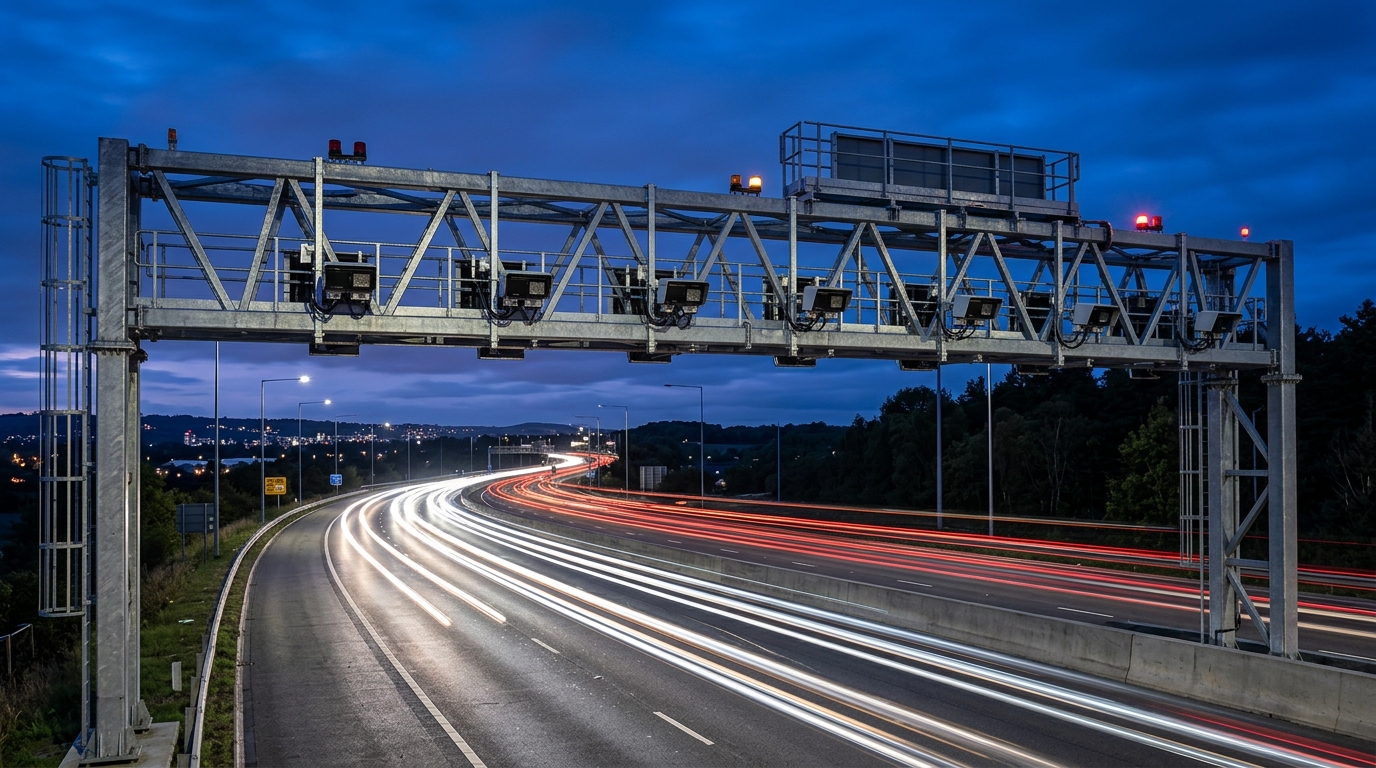
Unlike fixed highway gantry arrays – where vehicles pass through precisely defined lanes under fixed optical geometry – mobile municipal enforcement vehicles capture targets across highly variable yaw and pitch angles. As a mobile enforcement unit drives down narrow avenues, targets parked in parallel, diagonal, or reverse-bay configurations present acute parallax distortion. If the OCR engine does not incorporate continuous affine transformation rectification prior to character segmentation, character misreads (e.g., mistaking ‘8’ for ‘B’ or ‘0’ for ‘D’) escalate exponentially.
2. Shutter Intervals, Lux Variability, and Contrast Occlusion
Tropical urban environments like Penang introduce extreme dynamic lighting: torrential monsoons, harsh direct equatorial sunlight producing deep shadows, and low-pressure sodium street lamps at night. Consumer-grade or mid-tier security sensors lack the global shutter mechanisms and high-intensity pulsed 850nm infrared (IR) strobes required to isolate retroreflective license plates without motion blur or backlight blowout. When optical shutter intervals fail to adjust dynamically within a 1/500 to 1/10,000 second window, raw frames become noisy, degrading inference model confidence scores below legal evidentiary standards.
ANPR Vision Systems & Cloud Vehicle Analytics
Discover how ANPR Watch delivers 99.4% optical character accuracy for automated parking enforcement, highway tolling, and security checkpoints.
Systemic Governance: The Three Pillars of Defensible Automated Enforcement
To avoid the civic backlash seen in Penang, enterprise technology leaders and municipal transport directors must engineer systemic resilience into every layer of their vision-enforcement stack. Defensible automation relies on three architectural pillars:
Dual-Sensor Telemetry (Context + IR)
An IR-only capture guarantees clean alphanumeric segmentation but completely lacks contextual defensibility in an administrative appeal. Modern enforcement platforms must capture synchronized dual-frame metadata: an infrared image tuned specifically for plate reflectivity, alongside a high-resolution, wide-angle contextual color frame. The wide-angle sensor proves whether a vehicle’s hazard lights were active, whether loading activity was underway, or if the vehicle was blocked by passing traffic.
Stateful Temporal Verification vs. Stateless Triggering
Enforcement must never be executed on a single observation. A stateless snapshot only proves a vehicle was present at a single instant in time. A stateful architecture enforces a multi-pass temporal window: enforcing a programmatic 10-to-15 minute buffer where multiple passes or synchronized parking-meter API queries verify that no active payment session was initiated before an infringement record is assembled.
Automated Privacy Redaction (PDPA / GDPR Compliance)
Public outcry is frequently fueled by data privacy fears. Municipal smart city initiatives must incorporate edge-based PII (Personally Identifiable Information) masking. Passengers, pedestrians, and adjacent private property captured within the contextual color frame must undergo real-time Gaussian blurring at the edge before any telemetry packet is ingested into central cloud analytics.
Municipal & Commercial ANPR Architecture Matrix
The operational gap between legacy vision implementations and high-assurance municipal platforms dictates civic success or public backlash:
| Architectural Dimension | Vulnerable Deployment (e.g., Penang Pre-Pause) | Resilient Enterprise Standard |
|---|---|---|
| Capture Modality | Single-sensor optical camera; prone to ambient glare & low-light degradation. | Pulsed 850nm IR global-shutter sensor paired with synced contextual color imager. |
| Decision Engine | Stateless single-frame capture; immediate citation auto-generation. | Stateful temporal multi-pass buffer + active API integration with parking payment DBs. |
| Human-in-the-Loop (HITL) | Bypassed or minimized to maximize citation issuance velocity. | Mandatory human adjudication for all confidence scores below 98.5%. |
| Data Governance | Unredacted frame streaming to central storage; high privacy risk. | Edge PII masking (pedestrians/faces blurred); ephemeral non-infringement purge. |
The Path Forward for Public Sector Smart Infrastructure
The halt of ANPR enforcement in Penang should not be interpreted as an indictment of computer vision technology, but rather as an essential maturation point for automated governance. Automated enforcement cannot operate as an adversarial revenue extractor. It must be implemented as an auditable, fair, and technically rigorous operational tool.
By shifting to edge analytics platforms that combine ultra-low false-positive character validation, dynamic environmental compensation, and verifiable grace-period heuristics, municipal leaders and parking operators can eliminate administrative disputes, protect civil liberties, and rebuild public trust.
Enterprise FAQ
How does high-spec ANPR differentiate between stopping in traffic and illegal parking?
Advanced systems utilize multi-pass spatial-temporal verification. By measuring the vehicle’s position relative to curb demarcations over successive observation frames and cross-referencing wheel rotation metrics, the engine validates whether a vehicle is stationary or momentarily queued in traffic before initializing any enforcement timer.
What optical confidence threshold should be required before issuing automated citations?
Enterprise standards dictate a minimum deterministic confidence score of 98.5% across all alphanumeric characters on the plate. Any capture falling between 90% and 98.4% should automatically be routed to an authorized human adjudicator alongside the contextual color frame, while scans under 90% are discarded entirely.
How can municipal ANPR platforms comply with local data protection acts (e.g., PDPA / GDPR)?
Compliance requires strict edge-processing safeguards: automated real-time blurring of human faces and non-target vehicles, localized plate extraction, end-to-end TLS 1.3 encryption for metadata in transit, and a deterministic retention policy that auto-deletes non-infringing vehicle passes within a rolling 24-to-48 hour window.