
Executive Briefing
- Transitioning from RFID-only FASTag to hybrid Vision AI & ANPR architectures eliminates toll revenue leakage from tag spoofing and damaged windshields.
- Edge-accelerated deep learning models achieve sub-50ms inference speeds, processing high-velocity commercial vehicles moving at speeds up to 120 km/h.
- Real-time cloud analytics unify multi-lane free-flow (MLFF) infrastructures, driving frictionless mobility across India’s expanding national highway corridors.
The Paradigm Shift in Indian Highway Monetization
As India’s National Highways Authority (NHAI) continues to aggressively expand national transit corridors, the limitations of legacy Radio Frequency Identification (RFID) FASTag infrastructures have become glaringly apparent. While RFID deployment dramatically reduced manual cash queues, systemic vulnerabilities – including tag tampering, electronic interference, insufficient balance accounts, and physical obstruction – continue to cause massive revenue leakage and lingering bottlenecks at toll plazas. Enter Vision AI and advanced Automatic Number Plate Recognition (ANPR), fundamentally rewriting the blueprint for high-speed highway tolling and intelligent traffic management.
By combining high-definition optical sensors with localized neural processing units (NPUs), modern ANPR architectures bypass the single-point-of-failure risks associated with tag-only systems. Optical validation serves as a cryptographic ground-truth anchor, corroborating electronic toll collection (ETC) data against physical license plates with remarkable accuracy, regardless of atmospheric pollution, glare, or vehicular velocity.
Architectural Anatomy of High-Speed ANPR Toll Integration
Deploying computer vision systems across chaotic multi-lane Indian highway environments presents severe engineering challenges. Standard surveillance setups fail when confronted with varying vehicle geometries, dirty or non-standard high-security registration plates (HSRP), and extreme illumination swings from blazing midday sunlight to unlit rural night driving. Enterprise-grade vision deployment demands a rigorous edge-to-cloud topology:
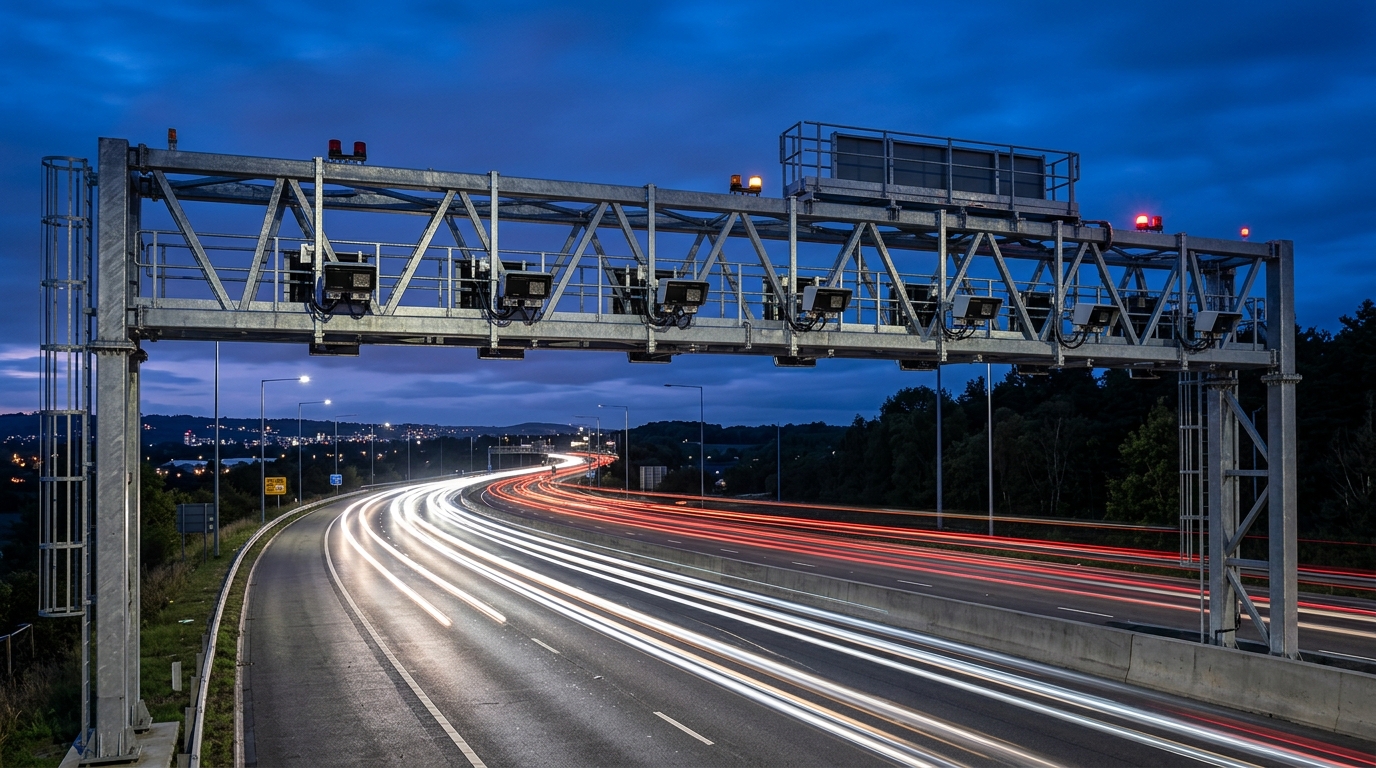
- Optical Capture Layer: Global-shutter industrial CMOS sensors equipped with synchronized pulsed infrared (IR) illumination arrays to eliminate motion blur at vehicle speeds exceeding 120 km/h.
- Edge Processing Units: Embedded GPUs or specialized NPUs running quantized Convolutional Neural Networks (CNNs) locally at the gantry, guaranteeing inference latencies under 50 milliseconds without depending on upstream backhaul stability.
- Character Segmentation & Recognition (OCR): Transformer-based vision models fine-tuned specifically for Indian script variants, regional font stylization, and varied plate deterioration levels.
- Central Clearinghouse Integration: Secure RESTful APIs streaming encrypted transaction packets via MQTT protocols into national transit databases for instant debit reconciliation.
ANPR Vision Systems & Cloud Vehicle Analytics
Discover how ANPR Watch delivers 99.4% optical character accuracy for automated parking enforcement, highway tolling, and security checkpoints.
Overcoming India-Specific Edge Deployment Challenges
Scaling optical toll collection across diverse geographical terrains requires resilience against erratic power grids, high ambient temperatures, and dust accumulation. Enterprise architectures must incorporate hardware-level fail-safes:
| Challenge | Legacy Toll Approach | Vision AI & ANPR Mitigation |
|---|---|---|
| Tag Spoofing & Swap | Relies exclusively on RFID reads | Cross-validates RFID UID against optical plate text |
| High-Speed Blur | Standard video framing (25fps) | Global shutter sensors with 1/2000s optical exposure |
| Power Outages | Plaza operational blackout | Edge battery backup with localized offline store-and-forward |
| Mud & Dirt Obfuscation | Manual inspection failure | Multi-spectral imaging parsing obscured character edges |
Implementation Checklist for Highway Authorities
- Conduct comprehensive site surveys to map gantry lighting angles and eliminate morning/evening direct sun blinding.
- Deploy dual-sensor cameras capturing both high-contrast monochrome optical plates and color contextual vehicle overviews.
- Implement containerized edge microservices to streamline over-the-air (OTA) model weight updates.
- Establish strict TLS 1.3 encryption pipelines for all data in transit from gantry edge devices to central cloud billing engines.
- Run rigorous baseline benchmarking for character recognition accuracy against diverse regional license plate cohorts.
Enterprise FAQ
How does Vision AI handle non-standard or dirty license plates common on Indian roads?
Modern ANPR engines employ multi-stage machine learning pipelines that first localize the plate region using object detection (such as YOLOv8 variations), correct perspective distortion, and then pass cropped imagery through attention-based OCR models trained on extensive datasets of weathered, muddy, and customized Indian registration plates.
What is the typical ROI timeline for upgrading a toll plaza to hybrid ANPR?
Most highway operators realize a full capital expenditure recovery within 8 to 14 months purely through the dramatic reduction of uncollected tolls, elimination of tag spoofing, and lower manual intervention overhead.
How do ANPR systems maintain operation during optical degradation from heavy monsoon rains?
By utilizing polarized near-infrared (NIR) strobes that pierce through heavy downpours and fog combined with optical lens heaters and self-cleaning hydrophobic glass coatings, high-end ANPR setups maintain above 98% capture fidelity during severe weather anomalies.