
Executive Briefing
- Recent UK transport policy shifts mandate real-time edge processing for instant vehicle seizure and penalty point issuance on motorways.
- Modern automatic number plate recognition (ANPR) systems must achieve sub-50ms latency connecting optical frames to the DVLA and MID databases.
- Enterprise fleet managers and highway authorities face heightened compliance burdens, requiring advanced optical character recognition (OCR) with 99%+ accuracy.
The Evolution of UK Motorway Enforcement: Real-Time Edge Intelligence
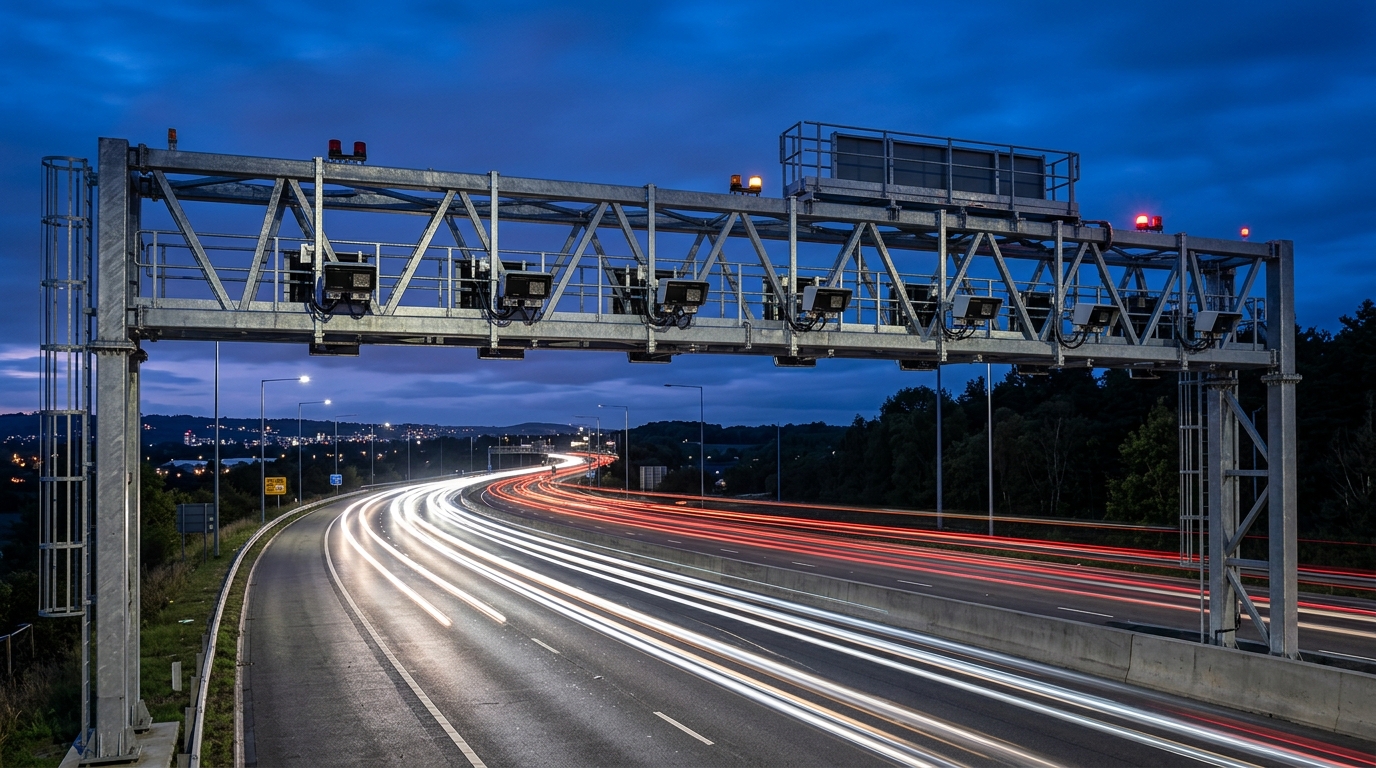
The latest regulatory frameworks governing UK motorways represent a fundamental architectural leap in automated traffic enforcement. Moving beyond passive logging and delayed retrospective fines, new high-speed motorway cameras are engineered for instant data-loop closure. When a vehicle passes a gantry, optical frames are processed at the edge to instantly cross-reference the Vehicle Excise Duty (VED), MOT status, and the Motor Insurance Database (MID). If a non-compliance vector is detected, the system triggers automated enforcement protocols, flagging the vehicle for immediate interception, point allocation, and physical seizure.
For municipal authorities, highway operators, and private security infrastructure designers, this operational pivot demands a rethinking of camera hardware, optical shutter intervals, and backend API throughput. High-velocity transit environments present extreme challenges: variable lighting, high closure speeds exceeding 100 mph, and environmental occlusions like spray and glare require specialized optical engineering.
Technical Architecture of Instant-Action ANPR Nodes
Achieving real-time vehicle seizure capability requires an end-to-end distributed computing pipeline. Traditional cloud-only round-trips introduce unacceptable network latency (often 200ms to 800ms), which is incompatible with fast-moving motorway traffic lanes. Modern enterprise-grade ANPR deployments utilize a split-architecture:
- Edge Capture & Processing: High-resolution CMOS sensors equipped with global shutters and integrated infrared (IR) illuminators capture crisp plate imagery regardless of ambient lighting. Onboard neural processing units (NPUs) execute localized character segmentation and normalization.
- Encrypted Middleware Transport: Normalized plate strings are packaged into lightweight JSON payloads and transmitted via encrypted TLS 1.3 tunnels over 5G/Fiber backhauls to centralized enforcement dispatchers.
- Database Synchronization: High-throughput microservices query national vehicular registries in real-time, executing ACID-compliant state checks to confirm insurance and tax lapses before automated alerts are generated.
ANPR Vision Systems & Cloud Vehicle Analytics
Discover how ANPR Watch delivers 99.4% optical character accuracy for automated parking enforcement, highway tolling, and security checkpoints.
Infrastructure Planning & Compliance Checklist
Deploying instantaneous enforcement hardware along high-speed corridors requires strict adherence to calibration, data privacy (GDPR), and network redundancy standards. Use the following deployment checklist to evaluate your current or planned infrastructure:
| Component | Enterprise Requirement | Performance Target |
|---|---|---|
| Optical Sensor | Global shutter with variable IR pass filtering | Up to 120 FPS at 4K resolution |
| OCR Engine | Deep learning neural network for font variance | >99.4% character match accuracy |
| Network Resilience | Dual-SIM 5G failover with local buffer storage | 99.999% uptime SLA |
| Data Compliance | Automated PII masking and encrypted audit trails | Fully GDPR/DPA compliant |
Enterprise FAQ
How do modern ANPR cameras handle obscured or dirty plates at motorway speeds?
Enterprise systems utilize multi-frame exposure stacking and advanced spatial interpolation. Infrared illumination penetrates mild dirt layers, while deep learning models trained on millions of degraded plates reconstruct obscured characters with high statistical confidence.
What is the typical latency between vehicle capture and database validation?
With edge-computed OCR and optimized fiber or 5G motorway backhauls, the round-trip latency from optical capture to database match is typically under 50 milliseconds, allowing real-time flagging for intercept units.
How do these systems maintain compliance with data protection regulations?
Captured video frames that do not match target enforcement criteria are automatically purged or anonymized at the edge. Only verified non-compliant records are retained within secure, access-controlled law enforcement repositories.
