
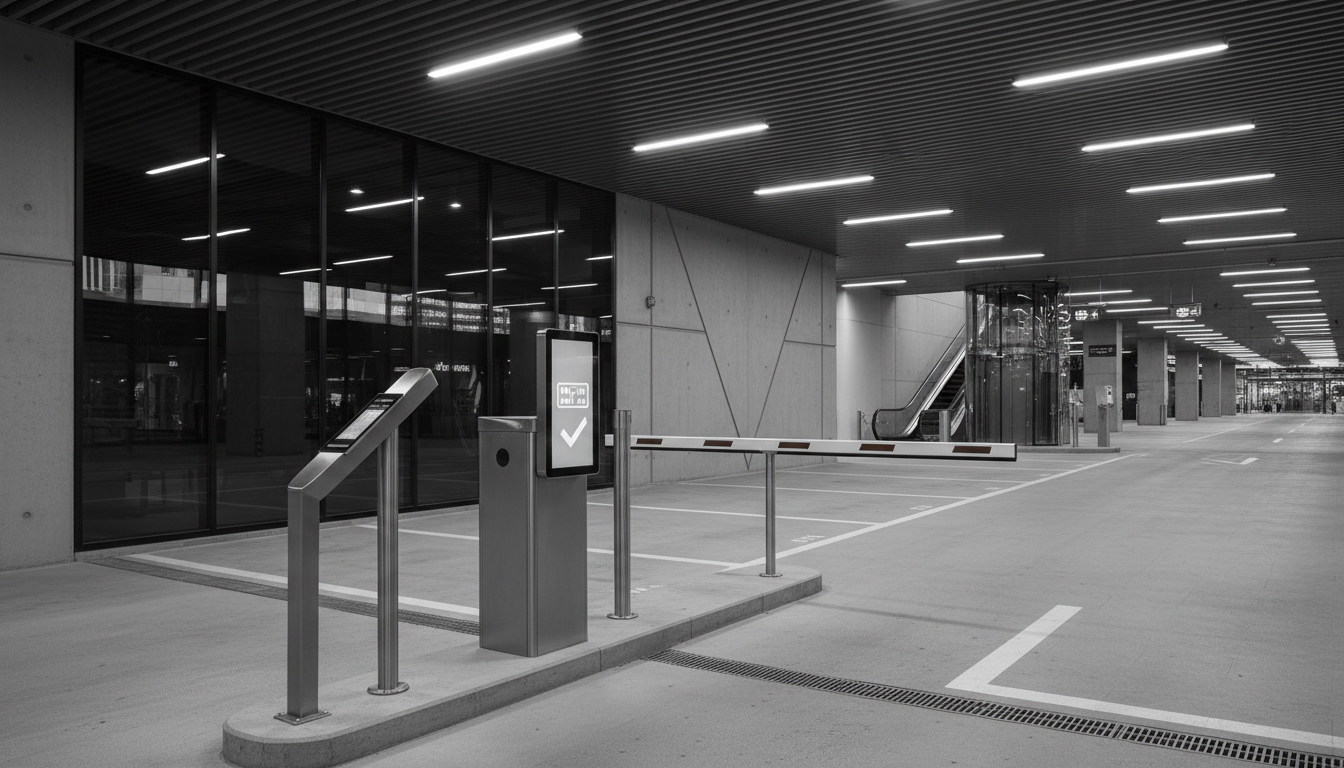
The facilities manager of a 2,200-space retail center on Al Wasl Road in Dubai faced a recurring financial mystery every month: the mall’s point-of-sale revenue reports consistently registered a 14% discrepancy against physical vehicle loop counts at entry and exit lanes. Over two quarters, uncollected parking fees and unsanctioned manual barrier overrides drained more than AED 380,000 from the property’s top line. The root cause was not a lack of physical security staff, but a fragmented optical infrastructure that failed to match dual-language license plates across entry and exit portals, leaving gate barriers open to systematic exploitation.
Anatomy of the AED 380,000 Revenue Siphon in High-Traffic Dubai Garages
Revenue leakage in commercial parking structures rarely stems from a single catastrophic system failure. Instead, it occurs through hundreds of daily micro-losses that compound across peak operating hours. When an optical character recognition (OCR) camera misses a plate at entry, the automated system cannot generate a matching entry timestamp upon exit. The default fallback in legacy setups relies on manual intervention by security personnel, creating an immediate vulnerability.
During a 30-day forensic audit of three multi-level parking sites across Dubai, operational logs revealed three primary drivers of lost revenue:
Executive Briefing
- Regional Optical Resilience: Optimized 850nm/940nm pulsed infrared illumination cuts through extreme solar glare, heat haze, and regional sandstorms.
- Multi-Jurisdiction Plate OCR: High-accuracy neural network OCR parses diverse regional formats (private, commercial, police, and export plates) across the GCC.
- BMS & Barrier Integration: Direct webhook and relay integration with existing barrier controllers ensures frictionless, sub-second vehicle ingress.
- Unmatched Exit Events: High camera misread rates forced garage guards to issue “lost ticket” exit vouchers manually, often charged at nominal flat rates rather than actual accrued hourly fees.
- Tailgating and Loop Manipulation: Secondary vehicles following closely behind authorized cars bypassed entry triggers before the barrier arm lowered, entering the facility completely untracked.
- Plate Substitution Fraud: Fraudulent drivers entered with a short-term vehicle, swapped physical tickets or manipulated barrier logic with insider help, and exited using a minimum-fare validation.
In high-density retail environments where parking turnover exceeds four cycles per bay daily, an uncaptured 5% error rate on license plate recognition camera software translates directly to hundreds of thousands of Dirhams in lost annual yields.
Audit Findings: Optical Misreads, Barrier Override Fraud, and Sync Latency
The technical audit evaluated optical performance, network latency, and physical barrier integration across 48 active lanes. The findings highlighted that legacy optical systems struggled specifically with the regional plate design diversity unique to the United Arab Emirates and broader GCC traffic.
Ticketless Parking & Cloud Vehicle Analytics
Discover how ANPR Watch automates barrier-free parking garages, valet operations, and dynamic revenue enforcement with 99.4% optical accuracy.
Dual-Language OCR Failures and GCC Plate Complexity
Vehicles operating in Dubai display a mix of local white plates, regional Abu Dhabi red-band formats, private classic vehicle identifiers, and neighboring GCC plates from Saudi Arabia, Oman, and Kuwait. Standard optical engines optimized solely for Western alphanumeric structures frequently misread Arabic character sets or failed to differentiate between Dubai plate codes (such as Code A versus Code AA) when mounted at sharp vertical angles.
A statistical analysis published by the British Parking Association demonstrates that optical misread rates above 3% in automated barriers increase site operating costs by up to $4.20 per vehicle due to manual exception handling and delayed exit lane processing.
When an entry camera misidentifies a character—for example, mistaking an Arabic digit for a Latin letter—the central parking management system treats the exiting vehicle as an unknown entity. Without a recognized entry record, the software cannot calculate the correct tariff, forcing the operator to grant a manual gate release.
Hikvision and Dahua Camera Hardware Misconfigurations
Many commercial sites across Dubai utilize high-grade hardware, including Hikvision and Dahua optics. However, the field audit revealed that hardware alone does not guarantee accuracy. Incorrect shutter speed settings, absent polarizers, and uncalibrated dynamic range controls caused severe infrared bounce-back off metallic plates during bright daylight hours, while underground garage entrances suffered from extreme backlight compensation delays when vehicles transitioned from direct sunlight into low-lux basements.
Proper Hikvision ANPR integration and optimized Dahua ANPR software parameters require distinct shutter profiles for day and night cycles, combined with hardware-level trigger integration via physical inductive loops rather than software-only motion triggers.
Calibrating License Plate Recognition Camera Software for GCC Plate Formats
Achieving 99%+ optical recognition accuracy across Gulf cooperation council plate formats requires dedicated image pre-processing algorithms and dual-stream character extraction. Modern automatic number plate recognition Dubai deployments must process both the Latin and Arabic alphanumeric fields simultaneously, cross-referencing the plate color coding and jurisdiction tag in real time.
Upgrading site optical software to modern engine builds restores baseline capture integrity. Sites utilizing comprehensive smart city ANPR software rely on neural
