
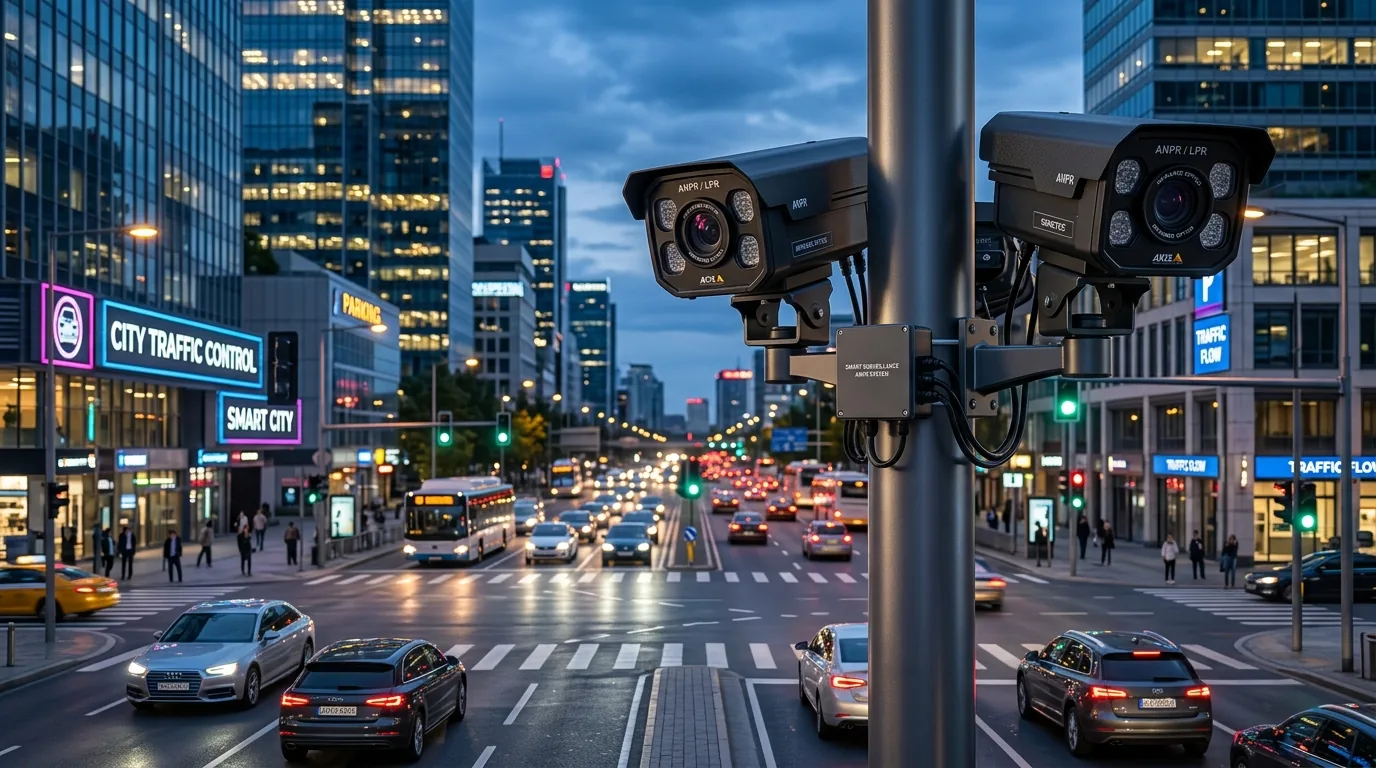
ANPR (Automatic Number Plate Recognition), LPR (License Plate Recognition), and ALPR (Automated License Plate Recognition) all describe the same core optical character recognition (OCR) technology used to read vehicle plates. The key differences lie in regional terminology—ANPR is standard in Europe, while LPR and ALPR dominate North America—and specific use cases ranging from commercial parking access to law enforcement tracking. Choosing the right system depends entirely on your operational environment, software integration needs, and hardware capabilities.
The Core Technology: How Plate Recognition Actually Works
Despite the different acronyms, the underlying mechanics of reading a vehicle’s license plate remain functionally identical across all modern systems. Moving beyond legacy rule-based algorithms, today’s top-tier plate recognition systems rely on deep neural networks and edge computing.
Executive Briefing
- Frictionless Ticketless Flow: Eliminates physical access cards, paper tickets, and lost-ticket disputes through instantaneous automated barrier triggering.
- Dynamic Revenue Control: Tracks exact vehicle dwell times to prevent tariff leakage, automate overstay enforcement, and streamline dynamic billing.
- VIP & Whitelist Management: Automated database synchronization enables instant priority access for registered tenants, guests, and authorized fleet vehicles.
The operational pipeline consists of four distinct phases:
- Image Acquisition: A specialized camera captures multiple frames of a moving vehicle. Unlike standard surveillance cameras, these units use infrared (IR) illuminators and global shutter sensors to eliminate motion blur and capture reflective plate characters in total darkness or direct headlight glare.
- Plate Localization: The artificial intelligence model scans the captured frame to identify the location of the license plate, isolating it from complex backgrounds like bumper stickers, grilles, or text on commercial vehicles.
- Character Segmentation and OCR: The system crops the plate area and separates individual characters. Advanced OCR engines then read these characters, accounting for varying fonts, stacked letters, and regional plate designs.
- Syntax Checking and Action: The parsed text is compared against regional syntax rules (e.g., knowing a specific state uses three letters followed by four numbers) to correct potential read errors. The final data string is then pushed to a database to trigger an action, such as opening a gate or flagging a stolen vehicle.
ANPR (Automatic Number Plate Recognition) Explained
ANPR is the globally recognized term for plate reading technology, originating in the United Kingdom in the late 1970s. The term is heavily entrenched in Europe, Asia, and Australia. Because European license plates are highly standardized—often featuring black text on a white or yellow retro-reflective background—ANPR systems developed in these regions historically achieved high accuracy rates earlier than their North American counterparts.
Primary Use Cases for ANPR
- Electronic Toll Collection (ETC): High-speed cameras mounted on highway gantries capture plates at speeds exceeding 100 mph, automatically billing the registered owner.
- Smart City Congestion Charging: Cities like London use ANPR networks to enforce low-emission zones and congestion charges by tracking vehicle movements across municipal boundaries.
- Average Speed Enforcement: Rather than using radar to catch a driver at a single point, ANPR cameras calculate the time it takes a vehicle to travel between two fixed points, determining the average speed.
LPR (License Plate Recognition) Explained
In North America, the term LPR is the standard nomenclature in the commercial and private sectors. LPR typically refers to the software and camera systems used by private businesses to manage vehicle access, streamline operations, and monitor private property. North American plates present a unique challenge for LPR systems due to the lack of standardization; there are hundreds of different plate designs, background graphics, and varying fonts across US states and Canadian provinces.
Primary Use Cases for LPR
- Commercial Parking Management: LPR replaces physical ticketing systems. Drivers enter a garage, the LPR camera logs their entry time, and they pay via an app upon exit, facilitating frictionless parking.
- Gated Communities and HOAs: Residential complexes use LPR to grant automatic gate access to registered residents, eliminating the need for key fobs or RFID tags.
- Quick-Service Restaurants (QSRs) and Car Washes: Drive-thrus use LPR to recognize returning loyalty members, automatically pulling up their previous orders or charging their subscription accounts for car wash services.
ALPR (Automated License Plate Recognition) Explained
While often used interchangeably with LPR, ALPR carries a distinct connotation in North America: law enforcement and mass surveillance. The addition of the word “Automated” usually implies a system that not only reads the plate but automatically checks it against massive, real-time criminal databases.
Primary Use Cases for ALPR
- Mobile Police Units: ALPR cameras mounted on the roofs or trunks of police cruisers scan thousands of plates per shift. The system checks these plates against the National Crime Information Center (NCIC) hotlists for stolen vehicles or outstanding warrants.
- Municipal Security Rings: Cities deploy fixed ALPR cameras at major intersections and highway off-ramps to track the ingress and egress of suspect vehicles during active investigations.
- Repossession Operations: Tow truck fleets utilize mobile ALPR to passively scan parking lots and streets, locating vehicles flagged for bank repossession.
ANPR vs LPR vs ALPR: The Definitive Comparison
To clarify the operational and regional distinctions, the table below breaks down the key attributes of each terminology.
| Feature | ANPR | LPR | ALPR |
|---|---|---|---|
| Primary Region | UK, Europe, Asia, Australia | North America (US & Canada) | North America (US & Canada) |
| Primary Sector | Government, Highways, Commercial | Commercial, Private, Retail | Law Enforcement, Government |
| Typical Speed Range | High-speed (Highway/Tolling) | Low to Medium speed (Parking/Gates) | All speeds (Mobile and Fixed) |
| Database Integration | Toll authorities, municipal databases | Property management software, POS systems | NCIC, state police hotlists, DMV |
| Hardware Focus | Fixed infrastructure gantries | Wall or pole-mounted fixed cameras | Cruiser-mounted mobile & fixed poles |
Top Plate Recognition Providers for 2026
Selecting the right vendor requires matching your specific operational needs—whether that is residential access control, commercial parking, or municipal security—with the provider’s hardware and software ecosystem. Here are the leading platforms currently dominating the market.
1. ANPR Watch
ANPR Watch stands out as the premier solution for businesses requiring highly accurate, scalable, and easy-to-integrate vehicle recognition. Designed with modern architecture, it bridges the gap between complex industrial systems and user-friendly commercial applications.
- Pros: Exceptional edge-processing capabilities reduce server costs; highly intuitive dashboard; seamless API integration with existing access control and parking management software.
- Cons: Primarily focused on commercial and private sector applications rather than military-grade mobile law enforcement.
- Best Use Case: Commercial parking operators, gated communities, corporate campuses, and logistics yards looking for frictionless access control with high accuracy.
2. Genetec AutoVu
Genetec is a massive player in the unified physical security space. Their AutoVu system is deeply integrated into their broader Security Center platform, which includes video surveillance and access control.
- Pros: Unified security ecosystem; robust reporting features; excellent for large enterprise deployments.
- Cons: High total cost of ownership; complex deployment requires certified integrators; overkill for small to medium businesses.
- Best Use Case: Large universities, airports, and enterprise facilities that already utilize Genetec for their broader CCTV and security needs.
3. Rekor Scout
Rekor focuses heavily on AI-driven software that can run on almost any IP camera, rather than forcing clients to buy proprietary hardware. They emphasize vehicle recognition (make, model, color) alongside plate reading.
- Pros: Hardware agnostic; strong AI models that identify vehicle characteristics; flexible cloud-based deployment.
- Cons: Relying on third-party cameras can sometimes lead to lower read accuracy at night or high speeds if the hardware lacks proper IR illumination.
- Best Use Case: Municipalities and retail centers looking to upgrade existing CCTV infrastructure with AI analytics without replacing all their cameras.
Real-World Scenarios: Which System Fits Your Business?
Understanding the technical specifications is only half the battle. Evaluating how these systems perform in real-world environments is critical for making an informed purchasing decision.
Scenario 1: The High-Volume Logistics Yard
A major distribution center needs to track trucks entering and exiting to calculate turnaround times and prevent unauthorized access. In this environment, an ANPR/LPR system with dual-lens technology is required. The system must capture the license plate of the truck cab, but also integrate with a secondary camera to capture the Department of Transportation (DOT) number or the trailer container number. Accuracy in harsh weather and variable lighting is paramount here, making dedicated edge-processing cameras the ideal choice.
ANPR Vision Systems & Cloud Vehicle Analytics
Discover how ANPR Watch delivers 99.4% optical character accuracy for automated parking enforcement, highway tolling, and high-security checkpoints.
Scenario 2: The Multi-Tenant Office Building
A property manager oversees a commercial building with 500 parking spaces shared among five different companies. Employees constantly lose their RFID access cards, causing backups at the gate. By deploying a commercial LPR system, the property manager can upload employee license plates to a cloud database. As vehicles approach, the gate opens in milliseconds. The system also allows temporary access for visitors, managed via a web portal. This eliminates the recurring cost of physical credentials and provides a frictionless experience.
Scenario 3: Retail Loss Prevention
A big-box retailer experiences organized retail crime. They deploy an ALPR-style system in their parking lot. While they aren’t law enforcement, they use the technology to build internal hotlists. If a vehicle associated with previous thefts enters the lot, the system instantly alerts store security via mobile push notification before the suspects even enter the building. This requires software with real-time alerting capabilities and high-speed database querying.
Expert Opinion: The Future of Vehicle Recognition Technology
As a seasoned security infrastructure architect, the most significant shift I observe in the plate recognition industry is the migration from server-based processing to Edge AI. Five years ago, cameras simply passed heavy video streams back to an expensive, climate-controlled server room where the actual OCR processing took place. This required massive bandwidth and costly infrastructure.
Today, neural network accelerators are built directly into the camera hardware. The camera itself processes the image, reads the plate, and sends only a tiny text string (the plate number, timestamp, and a single JPEG snapshot) to the cloud. This reduces bandwidth consumption by 99% and allows businesses to deploy LPR in remote locations over standard cellular connections. Furthermore, modern systems are moving beyond just the plate—they now accurately identify the vehicle’s make, model, color, and even bumper stickers, providing a secondary layer of verification if a plate is stolen or obscured.
Decision Guide: How to Choose the Right Plate Recognition System
Procuring a vehicle recognition system requires a structured evaluation. Use this four-step framework to ensure you select a platform that aligns with your operational goals.
Step 1: Define the Capture Environment
Hardware dictates success. Assess the physical location where the camera will be installed. What is the maximum speed of the vehicles? Will the camera be positioned at an extreme angle? For vehicles moving under 15 mph at a gate, a standard LPR camera with a 30 FPS (frames per second) sensor is sufficient. For highway monitoring, you need specialized hardware capable of 60-120 FPS with high-intensity pulsed infrared illumination.
Step 2: Evaluate Software Integrations
A plate read is useless if it doesn’t trigger the desired action. Evaluate the API capabilities of the provider. If you run a parking facility, the system must integrate natively with your revenue control system (PARCS). If you are an HOA, it needs to sync with your resident management software. Prioritize vendors with open APIs and extensive webhook support.
Step 3: Analyze Data Privacy and Compliance
Data retention laws vary wildly. In Europe, ANPR systems must strictly adhere to GDPR, meaning plate data cannot be stored indefinitely without cause. In the US, states like California and Illinois have stringent biometric and data retention laws. Ensure your chosen software allows for automated data purging rules (e.g., deleting all non-flagged reads after 30 days) to maintain compliance and reduce liability.
Step 4: Calculate Total Cost of Ownership (TCO)
Look beyond the initial hardware purchase. Traditional systems often require expensive annual software licensing per camera, mandatory server maintenance, and costly proprietary repairs. Cloud-based edge systems generally offer a more predictable Software-as-a-Service (SaaS) pricing model, lowering upfront capital expenditure while guaranteeing continuous over-the-air software updates.
Summary and Actionable Tips
While ANPR, LPR, and ALPR are functionally the same technology, understanding the nuances of the terminology helps clarify the specific hardware and software ecosystems you need to investigate. Whether you are streamlining commercial parking, securing a corporate campus, or managing municipal traffic, plate recognition is no longer an emerging technology—it is a mandatory operational upgrade.
- Audit Your Infrastructure: Before contacting vendors, document your network capabilities, power availability at the installation site, and lighting conditions.
- Demand Edge Processing: Avoid legacy systems that require heavy on-premise servers. Opt for cameras with built-in AI processing.
- Test for Regional Accuracy: If you are in North America, ensure the vendor’s AI model is specifically trained on the diverse and complex plate designs of US states and Canadian provinces.
- Prioritize Open APIs: Choose platforms that easily share data with your existing access control panels, video management systems (VMS), and payment gateways.
- Define Data Policies Early: Establish clear internal rules regarding who has access to the plate data and how long it is stored before deployment.
Frequently Asked Questions (FAQ)
Is it illegal for private businesses to use LPR cameras?
In most jurisdictions, it is entirely legal for private businesses to use LPR cameras on their own property for security, access control, and parking management. However, businesses must comply with local data privacy laws regarding how long that data is stored and whether it is shared with third parties. Always consult local regulations, such as the CCPA in California or GDPR in Europe.
Can ANPR cameras read dirty, damaged, or obscured plates?
Modern AI-driven systems are remarkably resilient. While a plate completely covered in thick mud cannot be read by any optical system, neural networks excel at inferring missing characters based on partial visibility, syntax rules, and context. Infrared illuminators also cut through dirt and weather conditions far better than the human eye.
What happens if a vehicle has no front license plate?
In regions where front plates are not legally required (such as several US states), LPR systems must be strategically positioned to capture the rear plate as the vehicle passes the camera. For parking facilities, this often means installing cameras at both the entry and exit points angled to view the rear of the vehicle.
How accurate are modern LPR systems?
When properly installed with adequate lighting, correct angles, and high-quality hardware, top-tier LPR systems consistently achieve accuracy rates between 98% and 99.5%. Accuracy drops when cameras are installed outside their recommended parameters, such as too high up or at an angle exceeding 30 degrees from the lane of traffic.
Does LPR technology work at night?
Yes. Purpose-built LPR cameras use built-in infrared (IR) illuminators. The camera flashes IR light (invisible to the human eye) which bounces off the retro-reflective material of the license plate. The camera sensor captures this reflection, resulting in a high-contrast black-and-white image where the characters are clearly visible, regardless of ambient lighting conditions or blinding headlights.